Showing posts with label kids. Show all posts

Wednesday, January 15, 2014

Learning to Lead: Practicing Leadership Through Gameplay

We often think of leaders as naturally assertive and charismatic people. We envision Presidents, Generals, and CEOs as born leaders, destined to be in charge. By cultivating the myth that leaders are born, not made, our kids develop a narrow impression of who can be a leader in their own world. Perhaps it is the person who speaks the loudest or the one with a Captain’s “C” on their jersey. Children who fall outside of these categories become hesitant to take on leadership roles and so do not develop their leadership skills, reconfirming their belief that they are not fit to lead.

We must teach our kids that leadership is not an inherited ability, but rather a skill that takes practice to master. At Dynamix, we believe that learning and fun should go hand in hand. So, here are three simple games that each offer a different leadership learning opportunity for your group:

1. Call and Follow - Rotate Responsibilities
GOAL: To have multiple children practice leadership through communication. 
SET-UP: Blindfold all but one player. Have the blindfolded children form a train with their hands on each other's shoulders. Have the non-blindfolded player, the "Caller," stand on a chair.
GAME: The Caller guides the blindfolded train around the room using only their voice. To increase the challenge, scatter obstacles, like pylons, around the room for the group to avoid. 
LEADERSHIP LEARNING OPPORTUNITY: Have children take turns being the Caller. This will give multiple children the chance to practice their communication skills and feel in charge of the group. It will also allow everyone else to practice following different people's directions. 

2. Blind Crossing - Creative Twists
GOAL: To give less assertive children the chance to lead.
SET-UP: Scatter a few hula-hoops around the room. Have the whole group hold onto one long rope.
GAME: The entire group must cross from one end of the room to the other by only stepping inside the hula-hoops and never letting go of the rope. 
LEADERSHIP LEARNING OPPORTUNITY: Add a twist by blindfolding a few of the more assertive group members. For an extra challenge, you can also tell the blindfolded people they are not allowed to talk. By limiting the influence of the group's natural leaders, other children will have the opportunity to step up and fill the leadership void. In addition, it will give your traditional leaders the chance to practice listening to others. 

3. Find the Leader - Leadership by Example
GOAL: To demonstrate the power of leading by example. 
SET-UP: Have the group sit in a circle. Pick one child to be the “Detective” and have them wait outside of the room. Pick one person in the circle to be the “Leader.”
GAME: The group must watch the leader and copy whatever action they are doing at the time. The Leader must switch the action frequently. The detective must reenter the room and try to guess which person is the leader by watching the group. 
LEADERSHIP LEARNING OPPORTUNITY: After the game, discuss what it means to lead by example – through our actions, not our words. Have the group think about the power of our actions and how positive and negative choices may influence other people. 


Written by: Shira Lurie, Dynamix Toronto lead facilitator


Dynamix: Team-building for Kids and Teens, since 2002.

Wednesday, December 4, 2013

R- E - S - P - E - C - T

Respect – An age old term parents and educators beg of children with exhaustive repetition. If only children were respectful, we probably wouldn't need rules. If children were respectful, they would walk in the hallways, be considerate of one another, keep their hands to themselves, listen when spoken to. In fact, if kids were respectful, every decision they make would be in consideration of their peers, adults and environment.

So, how do we get children to just be respectful? Let’s first consider the hours in a day trying to get children to behave the way we expect them to. It often involves bribery, arguments, debates, threats, negotiations and punishments. By doing this, are we, in fact, teaching children how to be respectful? Or are we simply controlling their behaviour and actions? Is a child respectful when they do something nice for someone to avoid punishment? The simplest and most effective way to teach respect is to be respectful. All too often, the very behavior we expect our children not to engage in is the behavior we use to control them. Yelling at a child is only effective if we expect our children to do the same. 

Consider your relationship with a police officer. If an officer stops you for rolling through a stop sign at a snail’s pace and then berates you for the infraction, how would you feel toward the officer? Would you feel respected? Would you feel you deserved to be berated? Now, imagine this happened on a regular basis. Imagine the frustration and sense of hopelessness you would feel in the presence of the very people you thought were there to help and protect you. Now, imagine you are to the kids what the officer is to you.


My grade 9 teacher epitomized what it means to teach respect. He was the only teacher who did not require students to ask permission to go to the washroom. Sounds crazy? Not only did we not require permission, we did not take advantage of his lenient class management style. We would go one at a time and return promptly. So, what was the secret? It’s simple. Respect. He modeled the behavior he expected from us. By respecting us – we, in turn, respected him. And by respecting him, we learned to respect others. So, with all the tricks in the bag, the foremost method of raising respectful and considerate children is by modelling the behaviour. Speak like you would like to be spoken to, when you say no to a child, provide a fair reason and remember to make sure they always know how much you care.

Written by: Corey Szwarcok, Dynamix Co-founder.


Dynamix: Team-building for Kids and Teens, since 2002.

Picture taken from Google Images, source: https://blogger.googleusercontent.com/img/b/R29vZ2xl/AVvXsEighjyhsuS6K81zUtjoG6LIx8XgQHCchvj7EZ0N8i-DAgTAkwuWLz9iwGhoUFAehYDw6g3f4nPu1NDlMpdIaawblxHaoY2Gu4sqOIyMyzCjsaXdRsHBf25P4ujwkDd0cqPaRNTNON8sPGjH/s320/parents.jpg

Wednesday, November 20, 2013

Other important life skills that can be developed from Teamwork.

The piece of tape hung in the air, three feet from the ground. The small group of children stared at it.
“We have to get all of us over that? Without touching it!?” they exclaimed. All at once they burst into a number of conversations, each trying to speak over the other. The smallest among them stepped into the circle and quietly said to the rest; “I know how we could do this; but I need your help.” Slowly and patiently, he explained how it might work. Another child contributed her ideas and soon enough, they were all helping one another over the tape.
            Teamwork has always been an important social skill for children. As educational systems are adapting to include a larger component of group work, mirroring the work environment of today’s economy, now more than ever, children need exposure to team-building skills at a young age.
            Team-building and teamwork are integral life skills. Children stand to benefit from acquiring these skills; by learning how to work in a team they develop self-confidence and improve their communication skills. Working in a team setting, whether competitive (team sports) or recreational (after school programs, birthday parties etc.), children benefit from experiential learning by having a platform in which they can interact positively with one another. These benefits include:
  • Learning about leadership abilities
  • Practicing decision making processes
  • Improving communication skills
  • Developing conflict resolution methods
            Collective challenges are a great setting for bringing a group of children together by encouraging them to work together. A popular challenge for young children (that’s safe and fun to do at home) is to have a number of children stand on top of a durable fabric (a tarp, or old towel). There should be very little extra room around their feet. The challenge: flip the fabric onto its other side, without letting anyone’s feet touch the ground. Hint: Holding hands help. 

Written by: Gabriel Gosselin, Children’s Recreational Programmer


Dynamix: Team-building for Kids and Teens, since 2002.

Picture taken from Google Images, source: http://rlv.zcache.com/teamwork_kids_poster-r98a4b07cbc7646238022a77c8653d2a3_a640t_8byvr_512.jpg

Wednesday, November 13, 2013

The 3 C’s of Education


Educational institutions around the world are seeing higher instances of bullying, aggression, hyperactivity and many other behavioural problems. In acknowledging these issues and remembering that we are preparing children for their future in society, is education that focuses heavily on academic subjects really substantial?
Looking at Gardner’s theory of multiple intelligence, we see that the curriculum develops and caters to most of Gardner’s proposed realms of intelligence, be it Verbal, Mathematical and even Kinetic. Only what Gardner called Interpersonal and Intrapersonal intelligence is neglected (Gardner, 2011). These two realms of intellectual capability may be the key to preparing youth for a sound future. The 3 R’s, though not obsolete, need to be taught hand in hand with the 3 C’s: Character, Community and Choice. Educators
and parents alike should focus on building people of strong moral and ethical character, developing a sense of community and teaching the ability to make good choices.

Character—Encouraging children to question themselves, consider the consequences of their actions and understand certain universal values creates greater self-awareness, a greater awareness of others and more pro-social behaviour (Noddings, 2006). In today’s race to eradicate bullying, character education as a preventative measure operates under the philosophy that people with an awareness of their behaviour and the consequences of it will not take part in or tolerate behaviour like bullying.

Community—Instilling a “Social Spirit” is critical to creating active members, who feel a strong attachment to their community and understand the needs to contributing and building social structures (Montessori, 1914). Fostering collective ideals and giving students a chance to participate in the governance of their community not only provides them the ability to apply moral ideals and logical thinking, but empowers students to shape their world.


Choice—Children who feel like they can make choices will be more apt to engage in solving problems, rather than turning to learned helplessness. Giving children the ability to make choices about their own lives actually empowers them to step up and take responsibility. From this point, guidance can be given to help children make good choices. In other words, give them the forum while providing them with proper tools and the results will be positive.


The 3 C’s, Character, Community, and Choice, are not the only subject matter needed, but they should indeed be at the heart of the curriculum to produce children with just that; heart.

Sources Consulted
Gardner, H. (2011). Frames of Mind The theory of multiple intelligences. Philadelphia: Basic Books (original work published 1983)
Montessori, M. (1914). Dr. Montessori's own handbook. Frederick A. Stokes Company. Retrieved from http://www.archive.org/stream/drmontessorisow00montgoog#page/n10/mode/2up
Noddings, Nel. (2006). Critical Lessons: What Our Schools Might Teach But Do Not. Cambridge University Press. Retrieved 29 November 2011, from http://0-ib.myilibrary.com.mercury.concordia.ca?ID=45875

Written by Amanda Preston, Dynamix Teambuilding Professional.


Dynamix: Team-building for Kids and Teens, since 2002.

Picture taken from Google Images, source: http://firsttimehouseflipping.com/wp-content/uploads/2013/01/Three-Cs-300x204.jpg

Wednesday, November 6, 2013

Redefining Success: Wobbling Towards Excellence

Being a facilitator at Dynamix is a unique privilege.  First of all, it’s my job to play games all day.  It’s hard to beat that.  But my favourite part of facilitating is the lessons that come out of the games.  On the best days, the kids take home something new, and so do I. 

Let me share a story:

It’s about a team of accomplished teenage leaders.  They had cooperated solidly for the majority of our three-day retreat.  Their challenge, with me, was to make the Oreo, a humongous tire attached to yellow ropes, walk forwards.  They discovered a strategy in a matter of minutes.  Most groups had needed several rounds of trial and error.  I was extremely impressed.
But then, something happened.  The students noticed the wobbling of the tire, how it wasn't moving in a straight line, how it tilted slightly. They began to nit-pick, to adjust small things, trying to move the tire perfectly.  Within seconds, the team’s cohesion dissolved.  They criticized each other’s methods, barked orders at one another.  They even yelled at each other for not communicating properly.  I stopped the group. 
“Talk to me,” I said calmly.  “What’s going on?”
They began to list their mistakes:  Not enough listening. Not enough strategy.  Not enough using our resources.  Not enough.
And then, being experienced in the ways of leadership education, they preempted my next question: What do we do differently next time? There was no shortage of ideas for improvements. 
The team was in consensus: The Oreo challenge had been a flop.  But that’s not how it looked to an outside observer, like me.
“What did we do well?” I asked them.  No answers.
“How many of you think that we were successful today?” No hands.
“Does anyone remember what the goal of the challenge was?” Silence. 
Then, one student answered: “To get the Oreo to move.” 
“Exactly,” I said.  “And was the Oreo moving?”
A chorus of yes’s.
“Then were we successful?”
Some tentative nods.
“We did what we set out to do,” I reminded them.  “Can we take a moment to give ourselves a round applause for that?”
The conversation that followed was about the importance of celebrating our successes, however small.  It’s important to work towards excellence, but that doesn’t mean forgetting to acknowledge the fact that we’ve accomplished something.  The road to an optimal solution can be fraught with struggle and setbacks – these are good things, they help us learn.  But they can also be frustrating.  That’s why we have to stop to say, Was the oreo moving? To remind ourselves that, yes, it was.


Dynamix: Team-building for Kids and Teens, since 2002.
Photo taken from Google Images, source: 

Thursday, October 31, 2013

The Benefits of a Positive Recess Environment


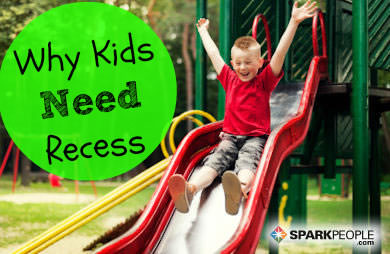
Everyday, elementary school children are given the opportunity to take a break from their schoolwork and go outside for recess. There are many benefits of allowing children to take recess breaks during school. From an educational perspective, children are found to be more attentive to academic work following recess and demonstrate improved cognitive performance on school related tasks (Pellegrini & Bohn, 2005). Recess can provide exercise and physical activity for children as a preventative measure for obesity (Barnett, O’Loughlin, Gauvin, Paradis, & Hanley, 2006). The social implications of recess are substantial and have a lasting effect on the developing child. Interacting with peers (rather than adults) at recess is a predictor of positive school achievement (Pellegrini & Smith, 1993), and the opportunities that exist for social interaction assist with developmental tasks—such as improved social skills and cooperative play—and building close relationships with peers (Pellegrini & Bohn). In general, recess behavior is a positive predictor of social cognitive development in children (Pellegrini & Smith). In addition to being proven in studies, teachers and parents often witness these positive outcomes of giving children a recess break during school.
Although recess time provides students with opportunities for positive growth, children don’t always necessarily receive these benefits. For many children, recess is not a time for positive social interaction or physical activity. It is important to keep children active and engaged on the schoolyard at recess and break times. Given the potential recess has for influencing the educational, cognitive, and social development of children, it is important that we take steps toward creating a positive recess environment that supports and encourages children to experience the benefits of recess time. Here are a few ways that peer-led, organized games on the schoolyard can help with this goal:
1.      Provides opportunities for inclusion and social interaction in play
Research on the benefits of peer interaction at recess suggests that peer-led games may be an excellent way of allowing children to engage in positive, meaningful interaction. Social skills and peer relationships often develop within the context of active, social games such as tag, soccer, and jump-rope (Pellegrini & Bohn).
2.      Provides structure in order to decrease opportunities for bullying
The elementary playground/schoolyard was found to be a school location where the highest frequency of bullying takes place (Vaillancourt et al., 2010). Organizing structured activities on the schoolyard may reduce bullying, as children are engaged in goal oriented, cooperative and, often, competitive tasks.

Let’s set our children up to succeed. If we do our part to create a positive recess environment, our children will thrive.

References:
Barnett, T. A., O’Loughlin, J., Gauvin, L., Paradis, G., & Hanley, J. (2006).
Opportunitites for student physical activity in elementary schools: A cross-sectional survey of frequency and correlates. Health Education & Behavior, 33(2), 215-232.
Pellegrini, A. D. & Bohn, C. M. (2005). The role of recess in children’s cognitive
performance and school adjustment. Educational Research, 34, 13-19.
Pellegrini, A. D. & Smith, P. K. (1993). School recess: Implications for education and
development. Review of Educational Research, 63(1), 51-67.
Vaillancourt, T., Brittain, H., Bennett, L., Arnocky, S., Mc.Dougall, P., Hymel, S., …
Cummingham, L. (2010). Places to avoid: Population-based study of school reports of unsafe and high bullying areas at school. Canadian Journal of School Psychology, 25(1), 40-54.

Written by: Shea Wood, Dynamix Montreal office.


Dynamix: Team-building for Kids and Teens, since 2002.
Picture taken from Google Images, source: http://www.sparkpeople.com/blog_photos/main/BigImages/recessG.jpg

Thursday, October 24, 2013

Strong Teams Stick Together: A Lesson in Cooperation

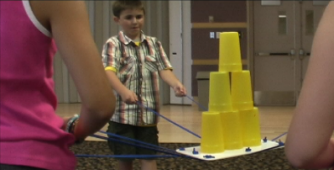
"Cooperation" author Virginia Burden summarized, "is the thorough conviction that nobody can get there unless everybody gets there." At Dynamix, we have multiple activities centered on this principle; games designed to encourage our students to move as one unit and arrive at their goal together. These are my favourite types of games because you can see group-consciousness forming in young minds right before your eyes. A child who loves being the fastest runner in her class, for example, decides to slow down so that her team can move at a more careful pace - an especially important choice as her team is trying to carry a pyramid of cups balanced on a board while only holding its strings! (It is as cool as it sounds - request 'Pyramid Insanity' for your next Dynamix Event!)

However, it took an extraordinary group of eight and nine year olds to show me the essence of Burden's point. We were playing an old Dynamix standby in which each team must travel to different "islands" (hula hoops) as a group using "magic floating" (foam) boards without falling into the "ocean" (floor). Once the whole team has one foot on their island (in the hula hoop), they are allowed to plant their team flag on it and move onto their next one. That's the key - everyone has to be there; they can't leave anyone behind. A little boy, whom I will rename "Arnold," was growing frustrated with this game. Travelling by foam boards requires the kids to squish together, and so allow their personal space to be invaded. Arnold appeared increasingly upset by this arrangement and made the choice to sit out for a few minutes to calm down. When Arnold's team arrived at their first island I asked, as I always do at this point of the game, "Ok, is everyone here? Can I give you your flag?" And, to my delight, many on the team replied, "No!" and pointed to Arnold. They had not forgotten about him; he was part of their team and they could not complete the task without him. Arnold beamed with pride as he rejoined his team to plant their flag.

Anyone who works with kids will agree that their choices are constantly surprising and insightful. That day, Arnold and his team showed me that it is not so much the destination that is important. After all, Arnold's team did make it to their first island without him. Of most significance to them was that they complete the task together. It is often the case in school or at work that one assertive member of a team takes over a project. The task gets done, but the team as a unit is unsuccessful. Cooperation, then, is the thorough conviction that nobody can accomplish their goal unless everybody helps to accomplish it. 

By Shira Lurie, Dynamix lead facilitator, Toronto Office


Dynamix: Team-building for Kids and Teens, since 2002.
Friday, October 12, 2012

How Social Media increases bullying

In this New York Times article, Emily Layden tells a story about her sixth grade brother’s friend posting a status on Facebook asking them to “LIKE if you hate” Emily’s brother. Shockingly, 57 people liked the status, confirming their “hatred” for Emily’s brother. Without a doubt, it would be incredibly damaging to a child’s self-esteem and self-worth to learn that 57 kids “hate” him or her.  As an adult, I couldn't imagine how this would affect me today.  Sometimes, it seems like it truly is “social warfare” out there for today’s youth, where social media is one of the strongest weapons in any potential enemy’s arsenal.
Does the boy who started this chain of “hate” for Emily’s brother grasp the extent of the harm he has caused? Do his 57 peers understand what that simple click of the mouse truly means? Could you imagine 57 children lining up at the cafeteria to tell one child they “hate” them? This would never happen, right?  Herein lies the power of social media messages, both positive and negative.  Simply put, it is so easy to spread the word, and as a result, bullying messages are spread at lightning speed.  In the cafeteria or classroom, a responsible adult usually takes notice and steps in. Alas, in the world of social media, it is quite difficult to take notice and step in before the damage is done.
So why are children so readily spreading these hate messages through social media?  Perhaps it’s the anonymity, perhaps it seems less harmful you can’t see the victim’s reaction or maybe it’s the freedom from adult supervision in the cyber world.
The question that has been asked over and over again by parents and educators is what do we do about this?  Should we simply ban the use of social media for our children?  Unfortunately, this is nothing more than a band-aid solution.  When addressing difficult situations like this we need to ask ourselves if  our “solution”  is really designed to teach our children, or does it just  make our  lives easier by making the problem go away. We need to seize every teachable moment we can, and cyberbullying is packed with teachable moments.  Below is a list of some things you can try to both prevent cyberbullying and address if it does occur:
Parents & Educators UNITE!
Note to parents: Cyberbullying is not only the teacher’s problem to deal with
Note to educators: Cyberbullying is not only the parent’s problem to deal with
Students UNITE!
Create connected school communities offline by helping your students get to know each other, unite as a team and foster positive relationships.  Students are less likely to act like a bully when they see each other as friends.  Even more powerful is the fact that other students are less likely to laugh with the bully, participate in the bullying, or stand idly by when they see the ‘victim’ as a friend.
Hold your children accountable for their decisions:
Whether online or offline, choices must be addressed and accompanied by consequences.  Notice here that we say “choices” not necessarily “bad choices”.  A good choice, like treating each other with respect should be accompanied by a good consequence.  Similarly, bad choices, like posting a negative online status a peer, should bring a negative consequence that creates an opportunity for learning.

Friday, May 15, 2009

Fun Fridays-Ep. 4- Victoria Day Weekend FIREWORKS!

Posted by Adam Kertesz

Looking to take the kids to see some fireworks on this beautiful long weekend? Well if you're like me and you had no idea they even did fireworks on Victoria Day Weekend, I'd like to help you out by suggesting a few places to check out (in Toronto):

The following is pulled directly from this site.

Victoria Day Fireworks

Free Fireworks Display at Ashbridges Bay Grab a blanket and head down to the Beaches on Monday May 18th to enjoy a free fireworks display that should start after 9:30pm. Of course if you head down earlier in the day you can stroll the shops and boardwalk and make sure you get a great spot to watch from. Just remember it will be cooler by the water, so dress appropriately and bring something comfy to sit on.
Fireworks at Ontario Place Victoria Day Weekend is also opening weekend at Ontario Place. The park will open at 10am all three days of the long weekend, closing at 6pm on Saturday and Monday. But on Sunday May 17th the park will stay open until 10pm so you can enjoy fireworks in the evening, beginning at 9:30pm. Of course, you can also just get near Ontario Place and keep your eyes on the sky.
Jubilee Queen Cruises - Fireworks Cruise If you'd rather see the fireworks from the water, Jubilee Queen Cruises offers a special evening cruise on the Victoria Day Weekend that also includes dinner and dancing. [/p
Fireworks at Canada's Wonderland Weather permitting, the giant theme park just north of Toronto will be putting on a fireworks display on Sunday May 17th at 10pm. Regular admission applies, so of course you'll want to get your money's worth and go much earlier in the day to enjoy the rides and entertainment too.

(And for all you history buffs out there, read all about the history of Victoria Day here.)

Have a great LONG weekend everyone!