Showing posts with label teamwork. Show all posts

Wednesday, February 19, 2014

Effective Communication in Teams: Sending Messages

Our daily lives are filled with one communication experience after the next. Communication between ourselves and those around us is constantly occurring as we exchange messages to achieve an understanding of other people’s thoughts and experiences. Effective communication is essential when working in teams, and developing the skills required to achieve mutual understanding within a team through communication takes practice. The word “team” is being used to describe any grouping of individuals—including a committee, class, sports team, family, or work colleagues—as communication is imperative despite the type of team being discussed. If we need to work collaboratively with others, we need effective communication.
In this article, I will offer some tips for sending messages effectively.
Tip #1: Take Ownership!
It is important to take responsibility for your opinions, ideas, and feelings when expressing them to others. To do this, make personal statements such as “I think…”, “I feel…”, “It seems to me…”. When you own your messages, it suggests that you are honest and open with your teammates, and there has been a level of trust established in the group that allows you to comfortably reveal your thoughts and feelings.

Something to watch out for: How often do you use sentences such as “We think that…”, “Everyone knows…”, “Most of the team feels…”? Take note of this! When we speak for other people, it might feel safer than taking ownership for our thoughts and feelings, but it may lead to confusion, misunderstanding, or inappropriate representation of someone else’s opinion.

Tip #2: Describe, Don’t Evaluate!
When giving feedback on someone else’s behavior, it is important to simply describe what you see without making a judgment about it. When we evaluate another’s behavior, it can create defensiveness and establish barriers to effective communication. It is helpful to use descriptive statements, which describe specifically what you have observed without making assumptions about what that behaviour means about the other person’s attitude, personality, or motives. For example, it can be more beneficial to tell a teammate “you seem to be walking very slowly, what’s going on?” rather than saying “you don’t care about finishing this challenge quickly”. We don’t have all of the information. Maybe the person is sick, upset, offended, tired, or hurt (among other possible reasons for this behavior), so simply giving descriptive feedback can begin a dialogue to establish a deeper understanding of you and your teammates’ experiences.

Something to watch out for: How often do you include judgment or an assumption when giving feedback rather than just describing what you see? Take note of this and see if you can alter your communication when giving feedback!

Tip #3: Take the Other’s Perspective
The same message can mean two different things to two different people. In order to send a message effectively, you need to consider the perspective of the receiver. Perspectives are complicated and complex; they are formed through our values, beliefs, and experiences. We can never be certain or complete in our understanding of another person’s perspective, but if we try to put ourselves in someone else’s shoes, we can create and send messages that are more likely to be received the way we intended. For example, if a teammate has absolutely no experience with soccer, and we consider this before sending our message, we may choose to say “try kicking the ball in the net” rather than “try to score a goal”, because the player may not know what it means to “score a goal”. Through perspective-taking, we can alter our communication so it can be more appropriate for the receiver and therefore more clearly understood.

Something to watch out for: How often do you phrase communication based on your own knowledge and experience without considering the perspective of the person your communicating with?

For more information, see Johnson (2014). Keep an eye out for my follow-up articles on tips for receiving messages effectively and overcoming possible obstacles to communication!

Reference
Johnson, D. W. (2014). Reaching out: Interpersonal effectiveness and self-actualization (11th ed.). Upper Saddle River, NJ: Pearson.


Written by Shea Wood, M.A., CCC

Dynamix: Team-building for Kids and Teens, since 2002.

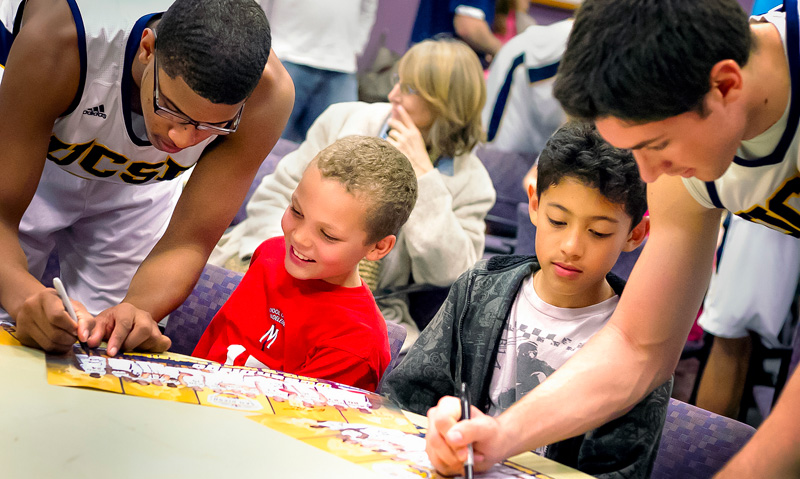
Picture taken from Google Images: http://ucsdnews.ucsd.edu/news_uploads/130321athletics1.jpg

Wednesday, January 8, 2014

Building Relationships in Teams: Self-Disclosure and Trust


When people work in teams, they build relationships. Strong relationships allow for more productive and meaningful teamwork and collaboration. This cycle highlights the importance of relationships in teamwork. Relationships develop through working in teams and relationships enable individuals to work together in meaningful ways.
Given the importance of building strong relationships, it is essential to consider what skills and behaviors lead to the creation of a strong and fulfilling relationships. By assisting children in developing these skills and behaviors, you are giving them tools to build a successful future that inevitably will require—and be enriched by—creating relationships and working with others. 
Self-Disclosure
Self-disclosure is an act of revealing your thoughts and perspective about a present situation, or other relevant and meaningful information, to another person. Sharing personal thoughts is crucial when building relationships in teams. Self-disclosure allows team members to get to know one another better, identify common goals and overlapping values and, once common goals have been identified, allows you to work together toward accomplishing these goals. Just as strong relationships and teams are built through appropriate self-disclosure, the lack of self-disclosure between team members can result in the deterioration of relationships and influence the strength of a team. If an individual keeps quiet about his/her needs, desires and goals, other team members are likely to do the same; people in relationships tend to match the amount of disclosure coming from others. A breakdown in communication can lead to a team where members are not working together or recognizing and valuing one another’s needs and desires.
Trust
It is well known that trust is the foundation for building and maintaining meaningful, productive relationships. This is certainly true of building relationships within a team, and when trust is established, team members are far more likely to take risks, communicate important information, and share personal thoughts and feelings through self-disclosure. Similar to the concept of self-disclosure, levels of trust are matched in relationships, and if one individual takes a risk and trusts others in the group, other team members are more likely to do the same. Feeling as though someone else trusts you makes it easier for you to trust that person in return. Johnson (2014) offers helpful hints about trust, and there are four that I believe are extremely helpful to remember when developing relationships within teams:
1.      Trust is hard to build and easy to destroy: building a high level of trust within relationships can take a long time, and one act of disloyalty can eliminate trust in a relationship.
2.      The key to building and maintaining trust is being trustworthy: as Johnson (2014) says, “when you want to increase trust, increase your trustworthiness” (p. 99).
3.      Trust needs to be appropriate: always trusting and never trusting is inappropriate. Evaluate the situation and trust yourself in knowing when it is important to extend trust to others.
4.      Cooperation increases trust; competition decreases trust: generally, trust develops between individuals who are working with one another rather than against one another.

Self-disclosure and trust are necessary in building relationships in many different contexts, including sports teams, the work environment, friend groups, and families. If adults can model these skills and behaviors, not only will the adults have more fulfilling and meaningful relationships, they will begin to teach their children how to build fulfilling and meaningful relationships in all areas of life.

Reference
Johnson, D. W. (2014). Reaching out: Interpersonal effectiveness and self-actualization (11th ed.). Upper Saddle River, NJ: Pearson.

Picture taken from Google Images: http://georgeclerie.files.wordpress.com/2012/08/kids-on-dock2.jpg

Written by Shea Wood.


Dynamix: Team-building for Kids and Teens, since 2002.

Wednesday, November 20, 2013

Other important life skills that can be developed from Teamwork.

The piece of tape hung in the air, three feet from the ground. The small group of children stared at it.
“We have to get all of us over that? Without touching it!?” they exclaimed. All at once they burst into a number of conversations, each trying to speak over the other. The smallest among them stepped into the circle and quietly said to the rest; “I know how we could do this; but I need your help.” Slowly and patiently, he explained how it might work. Another child contributed her ideas and soon enough, they were all helping one another over the tape.
            Teamwork has always been an important social skill for children. As educational systems are adapting to include a larger component of group work, mirroring the work environment of today’s economy, now more than ever, children need exposure to team-building skills at a young age.
            Team-building and teamwork are integral life skills. Children stand to benefit from acquiring these skills; by learning how to work in a team they develop self-confidence and improve their communication skills. Working in a team setting, whether competitive (team sports) or recreational (after school programs, birthday parties etc.), children benefit from experiential learning by having a platform in which they can interact positively with one another. These benefits include:
  • Learning about leadership abilities
  • Practicing decision making processes
  • Improving communication skills
  • Developing conflict resolution methods
            Collective challenges are a great setting for bringing a group of children together by encouraging them to work together. A popular challenge for young children (that’s safe and fun to do at home) is to have a number of children stand on top of a durable fabric (a tarp, or old towel). There should be very little extra room around their feet. The challenge: flip the fabric onto its other side, without letting anyone’s feet touch the ground. Hint: Holding hands help. 

Written by: Gabriel Gosselin, Children’s Recreational Programmer


Dynamix: Team-building for Kids and Teens, since 2002.

Picture taken from Google Images, source: http://rlv.zcache.com/teamwork_kids_poster-r98a4b07cbc7646238022a77c8653d2a3_a640t_8byvr_512.jpg

Wednesday, November 6, 2013

Redefining Success: Wobbling Towards Excellence

Being a facilitator at Dynamix is a unique privilege.  First of all, it’s my job to play games all day.  It’s hard to beat that.  But my favourite part of facilitating is the lessons that come out of the games.  On the best days, the kids take home something new, and so do I. 

Let me share a story:

It’s about a team of accomplished teenage leaders.  They had cooperated solidly for the majority of our three-day retreat.  Their challenge, with me, was to make the Oreo, a humongous tire attached to yellow ropes, walk forwards.  They discovered a strategy in a matter of minutes.  Most groups had needed several rounds of trial and error.  I was extremely impressed.
But then, something happened.  The students noticed the wobbling of the tire, how it wasn't moving in a straight line, how it tilted slightly. They began to nit-pick, to adjust small things, trying to move the tire perfectly.  Within seconds, the team’s cohesion dissolved.  They criticized each other’s methods, barked orders at one another.  They even yelled at each other for not communicating properly.  I stopped the group. 
“Talk to me,” I said calmly.  “What’s going on?”
They began to list their mistakes:  Not enough listening. Not enough strategy.  Not enough using our resources.  Not enough.
And then, being experienced in the ways of leadership education, they preempted my next question: What do we do differently next time? There was no shortage of ideas for improvements. 
The team was in consensus: The Oreo challenge had been a flop.  But that’s not how it looked to an outside observer, like me.
“What did we do well?” I asked them.  No answers.
“How many of you think that we were successful today?” No hands.
“Does anyone remember what the goal of the challenge was?” Silence. 
Then, one student answered: “To get the Oreo to move.” 
“Exactly,” I said.  “And was the Oreo moving?”
A chorus of yes’s.
“Then were we successful?”
Some tentative nods.
“We did what we set out to do,” I reminded them.  “Can we take a moment to give ourselves a round applause for that?”
The conversation that followed was about the importance of celebrating our successes, however small.  It’s important to work towards excellence, but that doesn’t mean forgetting to acknowledge the fact that we’ve accomplished something.  The road to an optimal solution can be fraught with struggle and setbacks – these are good things, they help us learn.  But they can also be frustrating.  That’s why we have to stop to say, Was the oreo moving? To remind ourselves that, yes, it was.


Dynamix: Team-building for Kids and Teens, since 2002.

Photo taken from Google Images, source: 

Thursday, October 24, 2013

Strong Teams Stick Together: A Lesson in Cooperation

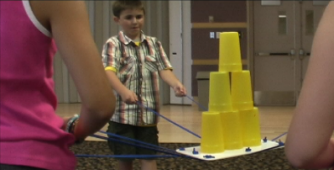
"Cooperation" author Virginia Burden summarized, "is the thorough conviction that nobody can get there unless everybody gets there." At Dynamix, we have multiple activities centered on this principle; games designed to encourage our students to move as one unit and arrive at their goal together. These are my favourite types of games because you can see group-consciousness forming in young minds right before your eyes. A child who loves being the fastest runner in her class, for example, decides to slow down so that her team can move at a more careful pace - an especially important choice as her team is trying to carry a pyramid of cups balanced on a board while only holding its strings! (It is as cool as it sounds - request 'Pyramid Insanity' for your next Dynamix Event!)

However, it took an extraordinary group of eight and nine year olds to show me the essence of Burden's point. We were playing an old Dynamix standby in which each team must travel to different "islands" (hula hoops) as a group using "magic floating" (foam) boards without falling into the "ocean" (floor). Once the whole team has one foot on their island (in the hula hoop), they are allowed to plant their team flag on it and move onto their next one. That's the key - everyone has to be there; they can't leave anyone behind. A little boy, whom I will rename "Arnold," was growing frustrated with this game. Travelling by foam boards requires the kids to squish together, and so allow their personal space to be invaded. Arnold appeared increasingly upset by this arrangement and made the choice to sit out for a few minutes to calm down. When Arnold's team arrived at their first island I asked, as I always do at this point of the game, "Ok, is everyone here? Can I give you your flag?" And, to my delight, many on the team replied, "No!" and pointed to Arnold. They had not forgotten about him; he was part of their team and they could not complete the task without him. Arnold beamed with pride as he rejoined his team to plant their flag.

Anyone who works with kids will agree that their choices are constantly surprising and insightful. That day, Arnold and his team showed me that it is not so much the destination that is important. After all, Arnold's team did make it to their first island without him. Of most significance to them was that they complete the task together. It is often the case in school or at work that one assertive member of a team takes over a project. The task gets done, but the team as a unit is unsuccessful. Cooperation, then, is the thorough conviction that nobody can accomplish their goal unless everybody helps to accomplish it. 

By Shira Lurie, Dynamix lead facilitator, Toronto Office


Dynamix: Team-building for Kids and Teens, since 2002.