
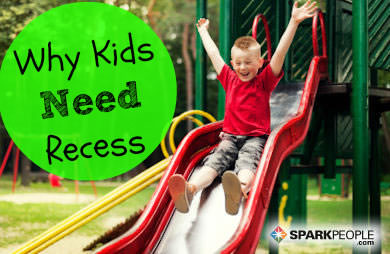
Everyday,
elementary school children are given the opportunity to take a break from their
schoolwork and go outside for recess. There are many benefits of allowing
children to take recess breaks during school. From an educational perspective,
children are found to be more attentive to academic work following recess and
demonstrate improved cognitive performance on school related tasks (Pellegrini
& Bohn, 2005). Recess can provide exercise and physical activity for
children as a preventative measure for obesity (Barnett, O’Loughlin, Gauvin,
Paradis, & Hanley, 2006). The social implications of recess are substantial
and have a lasting effect on the developing child. Interacting with peers
(rather than adults) at recess is a predictor of positive school achievement (Pellegrini
& Smith, 1993), and the opportunities that exist for social interaction
assist with developmental tasks—such as improved social skills and cooperative
play—and building close relationships with peers (Pellegrini & Bohn). In
general, recess behavior is a positive predictor of social cognitive
development in children (Pellegrini & Smith). In addition to being proven
in studies, teachers and parents often witness these positive outcomes of
giving children a recess break during school.
Although
recess time provides students with opportunities for positive growth, children don’t always necessarily receive
these benefits. For many children,
recess is not a time for positive social interaction or physical activity. It is important to keep children active and
engaged on the schoolyard at recess and break times. Given the potential
recess has for influencing the educational, cognitive, and social development
of children, it is important that we take steps toward creating a positive
recess environment that supports and encourages children to experience the
benefits of recess time. Here are a few ways that peer-led, organized games on
the schoolyard can help with this goal:
1. Provides
opportunities for inclusion and social interaction in play
Research on the benefits of peer
interaction at recess suggests that peer-led games may be an excellent way of
allowing children to engage in positive, meaningful interaction. Social skills
and peer relationships often develop within the context of active, social games
such as tag, soccer, and jump-rope (Pellegrini & Bohn).
2.
Provides structure in order to decrease
opportunities for bullying
The elementary
playground/schoolyard was found to be a school location where the highest
frequency of bullying takes place (Vaillancourt et al., 2010). Organizing
structured activities on the schoolyard may reduce bullying, as children are
engaged in goal oriented, cooperative and, often, competitive tasks.
Let’s set our
children up to succeed. If we do our part to create a positive recess
environment, our children will thrive.
References:
Barnett, T. A., O’Loughlin, J., Gauvin, L.,
Paradis, G., & Hanley, J. (2006).
Opportunitites for
student physical activity in elementary schools: A cross-sectional survey of
frequency and correlates. Health
Education & Behavior, 33(2), 215-232.
Pellegrini, A. D. & Bohn, C. M. (2005). The
role of recess in children’s cognitive
performance and school
adjustment. Educational Research, 34,
13-19.
Pellegrini, A. D. & Smith, P. K. (1993).
School recess: Implications for education and
development. Review of Educational Research, 63(1),
51-67.
Vaillancourt, T., Brittain, H., Bennett, L.,
Arnocky, S., Mc.Dougall, P., Hymel, S., …
Cummingham, L. (2010).
Places to avoid: Population-based study of school reports of unsafe and high
bullying areas at school. Canadian
Journal of School Psychology, 25(1), 40-54.
Written by: Shea Wood, Dynamix Montreal office.
Dynamix: Team-building for Kids and Teens, since 2002.
Picture taken from Google Images, source: http://www.sparkpeople.com/blog_photos/main/BigImages/recessG.jpg

