Showing posts with label recess. Show all posts

Wednesday, November 6, 2013

Redefining Success: Wobbling Towards Excellence

Being a facilitator at Dynamix is a unique privilege.  First of all, it’s my job to play games all day.  It’s hard to beat that.  But my favourite part of facilitating is the lessons that come out of the games.  On the best days, the kids take home something new, and so do I. 

Let me share a story:

It’s about a team of accomplished teenage leaders.  They had cooperated solidly for the majority of our three-day retreat.  Their challenge, with me, was to make the Oreo, a humongous tire attached to yellow ropes, walk forwards.  They discovered a strategy in a matter of minutes.  Most groups had needed several rounds of trial and error.  I was extremely impressed.
But then, something happened.  The students noticed the wobbling of the tire, how it wasn't moving in a straight line, how it tilted slightly. They began to nit-pick, to adjust small things, trying to move the tire perfectly.  Within seconds, the team’s cohesion dissolved.  They criticized each other’s methods, barked orders at one another.  They even yelled at each other for not communicating properly.  I stopped the group. 
“Talk to me,” I said calmly.  “What’s going on?”
They began to list their mistakes:  Not enough listening. Not enough strategy.  Not enough using our resources.  Not enough.
And then, being experienced in the ways of leadership education, they preempted my next question: What do we do differently next time? There was no shortage of ideas for improvements. 
The team was in consensus: The Oreo challenge had been a flop.  But that’s not how it looked to an outside observer, like me.
“What did we do well?” I asked them.  No answers.
“How many of you think that we were successful today?” No hands.
“Does anyone remember what the goal of the challenge was?” Silence. 
Then, one student answered: “To get the Oreo to move.” 
“Exactly,” I said.  “And was the Oreo moving?”
A chorus of yes’s.
“Then were we successful?”
Some tentative nods.
“We did what we set out to do,” I reminded them.  “Can we take a moment to give ourselves a round applause for that?”
The conversation that followed was about the importance of celebrating our successes, however small.  It’s important to work towards excellence, but that doesn’t mean forgetting to acknowledge the fact that we’ve accomplished something.  The road to an optimal solution can be fraught with struggle and setbacks – these are good things, they help us learn.  But they can also be frustrating.  That’s why we have to stop to say, Was the oreo moving? To remind ourselves that, yes, it was.


Dynamix: Team-building for Kids and Teens, since 2002.

Photo taken from Google Images, source: 

Thursday, October 31, 2013

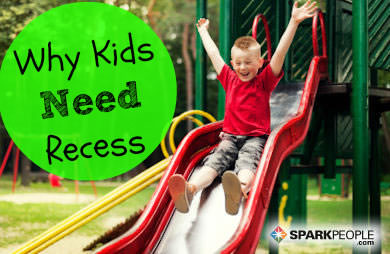
The Benefits of a Positive Recess Environment


Everyday, elementary school children are given the opportunity to take a break from their schoolwork and go outside for recess. There are many benefits of allowing children to take recess breaks during school. From an educational perspective, children are found to be more attentive to academic work following recess and demonstrate improved cognitive performance on school related tasks (Pellegrini & Bohn, 2005). Recess can provide exercise and physical activity for children as a preventative measure for obesity (Barnett, O’Loughlin, Gauvin, Paradis, & Hanley, 2006). The social implications of recess are substantial and have a lasting effect on the developing child. Interacting with peers (rather than adults) at recess is a predictor of positive school achievement (Pellegrini & Smith, 1993), and the opportunities that exist for social interaction assist with developmental tasks—such as improved social skills and cooperative play—and building close relationships with peers (Pellegrini & Bohn). In general, recess behavior is a positive predictor of social cognitive development in children (Pellegrini & Smith). In addition to being proven in studies, teachers and parents often witness these positive outcomes of giving children a recess break during school.
Although recess time provides students with opportunities for positive growth, children don’t always necessarily receive these benefits. For many children, recess is not a time for positive social interaction or physical activity. It is important to keep children active and engaged on the schoolyard at recess and break times. Given the potential recess has for influencing the educational, cognitive, and social development of children, it is important that we take steps toward creating a positive recess environment that supports and encourages children to experience the benefits of recess time. Here are a few ways that peer-led, organized games on the schoolyard can help with this goal:
1.      Provides opportunities for inclusion and social interaction in play
Research on the benefits of peer interaction at recess suggests that peer-led games may be an excellent way of allowing children to engage in positive, meaningful interaction. Social skills and peer relationships often develop within the context of active, social games such as tag, soccer, and jump-rope (Pellegrini & Bohn).
2.      Provides structure in order to decrease opportunities for bullying
The elementary playground/schoolyard was found to be a school location where the highest frequency of bullying takes place (Vaillancourt et al., 2010). Organizing structured activities on the schoolyard may reduce bullying, as children are engaged in goal oriented, cooperative and, often, competitive tasks.

Let’s set our children up to succeed. If we do our part to create a positive recess environment, our children will thrive.

References:
Barnett, T. A., O’Loughlin, J., Gauvin, L., Paradis, G., & Hanley, J. (2006).
Opportunitites for student physical activity in elementary schools: A cross-sectional survey of frequency and correlates. Health Education & Behavior, 33(2), 215-232.
Pellegrini, A. D. & Bohn, C. M. (2005). The role of recess in children’s cognitive
performance and school adjustment. Educational Research, 34, 13-19.
Pellegrini, A. D. & Smith, P. K. (1993). School recess: Implications for education and
development. Review of Educational Research, 63(1), 51-67.
Vaillancourt, T., Brittain, H., Bennett, L., Arnocky, S., Mc.Dougall, P., Hymel, S., …
Cummingham, L. (2010). Places to avoid: Population-based study of school reports of unsafe and high bullying areas at school. Canadian Journal of School Psychology, 25(1), 40-54.

Written by: Shea Wood, Dynamix Montreal office.


Dynamix: Team-building for Kids and Teens, since 2002.
Picture taken from Google Images, source: http://www.sparkpeople.com/blog_photos/main/BigImages/recessG.jpg

Friday, May 29, 2009

Fun Fridays- Ep. 6- RECESS!!

Posted by Adam Kertesz

This week's Fun Friday is an interactive one. Next week I plan to write a bit about recess and the sad reality that the games we all grew up playing are slowly being banned in schoolyards across North America.

So for now, I want to hear from you. What was your favourite game you playted at recess when you were a kid? If you are a kid, share with us what your favourite game is that you play these days! Just click on 'Comment' below to post your replies!

And then stay tuned for next week's blog about all things recess, including (spoiler and shameless plug alert!) Dynamix's brand new Recess Success program!

Have a great weekend everyone!