Showing posts with label conflict resolution. Show all posts

Wednesday, March 26, 2014

A Guide for Discussing RESPECT in the Classroom


As Corey has mentioned, conversations about respect can be complicated. We want our children to be respectful and considerate of others, but not because we have bribed, begged, or punished them. Teaching children, especially young ones, the value of respect is difficult. My advice is to tackle this subject through an open discussion in which the class decides together why respect is important to your classroom community.

Here are some questions you can use to guide your discussion and some answers you can probe for:

What is respect? What does it mean to be respectful?

-Respect is treating others the way you want to be treated.
-Being respectful means being considerate of others’ needs and feelings.

Who or what should we respect?

-We should show respect to everyone and everything. This means our classmates and teachers, but also our classroom and playground.
-We should respect ourselves.

What are some ways we can show respect in the classroom and/or at recess?

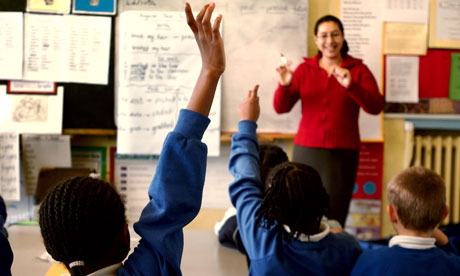
-Raise your hand and wait to be called upon before speaking.
-Put classroom supplies back where you found them.
-Follow the rules of any game being played.
-Never tease or make fun of another person.
-Dispose of garbage and recycling properly.

How will it make people feel when we are respectful towards them?

-They will feel like their feelings matter and that they have friends who care about them.
-They will think that school is a fun and safe place to be.

You can wrap up your discussion by having your students come up with a contract or pledge to be respectful that they will all sign. Whenever your students need a reminder, you can point to the agreement you all made together.

For additional resources, remember our Full of Character program has an entire session devoted to respect in the classroom!


Written by Shira Lurie, toronto lead facilitator


Image: http://static.guim.co.uk/sys-images/Guardian/Pix/pictures/2012/2/1/1328124903860/A-class-of-children-and-t-008.jpg

Wednesday, November 20, 2013

Other important life skills that can be developed from Teamwork.

The piece of tape hung in the air, three feet from the ground. The small group of children stared at it.
“We have to get all of us over that? Without touching it!?” they exclaimed. All at once they burst into a number of conversations, each trying to speak over the other. The smallest among them stepped into the circle and quietly said to the rest; “I know how we could do this; but I need your help.” Slowly and patiently, he explained how it might work. Another child contributed her ideas and soon enough, they were all helping one another over the tape.
            Teamwork has always been an important social skill for children. As educational systems are adapting to include a larger component of group work, mirroring the work environment of today’s economy, now more than ever, children need exposure to team-building skills at a young age.
            Team-building and teamwork are integral life skills. Children stand to benefit from acquiring these skills; by learning how to work in a team they develop self-confidence and improve their communication skills. Working in a team setting, whether competitive (team sports) or recreational (after school programs, birthday parties etc.), children benefit from experiential learning by having a platform in which they can interact positively with one another. These benefits include:
  • Learning about leadership abilities
  • Practicing decision making processes
  • Improving communication skills
  • Developing conflict resolution methods
            Collective challenges are a great setting for bringing a group of children together by encouraging them to work together. A popular challenge for young children (that’s safe and fun to do at home) is to have a number of children stand on top of a durable fabric (a tarp, or old towel). There should be very little extra room around their feet. The challenge: flip the fabric onto its other side, without letting anyone’s feet touch the ground. Hint: Holding hands help. 

Written by: Gabriel Gosselin, Children’s Recreational Programmer


Dynamix: Team-building for Kids and Teens, since 2002.

Picture taken from Google Images, source: http://rlv.zcache.com/teamwork_kids_poster-r98a4b07cbc7646238022a77c8653d2a3_a640t_8byvr_512.jpg