Wednesday, November 27, 2013

3 SIMPLE RULES: THE POWER OF POSITIVE IMPACT


Whether parenting or working with a large group of students, it is important we look at our own behaviour and the impact it has on our children’s actions. Although we may have the best of intentions, we inadvertently influence our children’s poor behaviour or negative choices. When dealing with a child who is misbehaving, it is easy to blame their environment, parents, friends or even nature. But by doing so, we are relinquishing all responsibility thus disabling us from making a difference. By owning the behaviour we are looking in a mirror and asking “What can I do to change the behaviour?”. Let’s look at 3 simple rules I like to remember when
working with children.

The first rule is “Set children up to succeed”. Imagine asking a child not to jump while standing on a trampoline or sit a group of children at a table for long period of time and ask them not to talk. Although children do have to learn to follow rules and “respect their elders”, they do have limits. Evaluating the likelihood of success before acting will create a more positive environment and prevent negative behaviour. By helping children to succeed, they learn success is possible and experience the intrinsic benefits which will leave them wanting more.

The second rule is “Be positive”. It may sound simple and perhaps obvious, but all too often we focus too much on negative behaviour rather than positive behaviour. Speaking negatively toward a child or

labeling a child will encourage the behaviour. Similarly, focusing on positive behaviour will encourage the behaviour to continue.

The third and final rule is “Connect with the child”. A relationship built on control will likely not give you

the results you seek. Nobody likes to be forced to do something. Have you ever tried to strap a child into a
car seat against their will? Connect with a child, build trust and respect and they will be willing to learn. By owning the behaviour we have the power to change the behaviour. Although it’s not easy, it’s amazing what we are capable of achieving. What are your rules?


Dynamix: Team-building for Kids and Teens, since 2002.

Picture taken from Google Images, source: http://www.a-spiritual-journey-of-healing.com/images/whats_wrong_with_me_stuart_rosen.jpg

Wednesday, November 20, 2013

Other important life skills that can be developed from Teamwork.

The piece of tape hung in the air, three feet from the ground. The small group of children stared at it.
“We have to get all of us over that? Without touching it!?” they exclaimed. All at once they burst into a number of conversations, each trying to speak over the other. The smallest among them stepped into the circle and quietly said to the rest; “I know how we could do this; but I need your help.” Slowly and patiently, he explained how it might work. Another child contributed her ideas and soon enough, they were all helping one another over the tape.
            Teamwork has always been an important social skill for children. As educational systems are adapting to include a larger component of group work, mirroring the work environment of today’s economy, now more than ever, children need exposure to team-building skills at a young age.
            Team-building and teamwork are integral life skills. Children stand to benefit from acquiring these skills; by learning how to work in a team they develop self-confidence and improve their communication skills. Working in a team setting, whether competitive (team sports) or recreational (after school programs, birthday parties etc.), children benefit from experiential learning by having a platform in which they can interact positively with one another. These benefits include:
  • Learning about leadership abilities
  • Practicing decision making processes
  • Improving communication skills
  • Developing conflict resolution methods
            Collective challenges are a great setting for bringing a group of children together by encouraging them to work together. A popular challenge for young children (that’s safe and fun to do at home) is to have a number of children stand on top of a durable fabric (a tarp, or old towel). There should be very little extra room around their feet. The challenge: flip the fabric onto its other side, without letting anyone’s feet touch the ground. Hint: Holding hands help. 

Written by: Gabriel Gosselin, Children’s Recreational Programmer


Dynamix: Team-building for Kids and Teens, since 2002.

Picture taken from Google Images, source: http://rlv.zcache.com/teamwork_kids_poster-r98a4b07cbc7646238022a77c8653d2a3_a640t_8byvr_512.jpg

Wednesday, November 13, 2013

The 3 C’s of Education


Educational institutions around the world are seeing higher instances of bullying, aggression, hyperactivity and many other behavioural problems. In acknowledging these issues and remembering that we are preparing children for their future in society, is education that focuses heavily on academic subjects really substantial?
Looking at Gardner’s theory of multiple intelligence, we see that the curriculum develops and caters to most of Gardner’s proposed realms of intelligence, be it Verbal, Mathematical and even Kinetic. Only what Gardner called Interpersonal and Intrapersonal intelligence is neglected (Gardner, 2011). These two realms of intellectual capability may be the key to preparing youth for a sound future. The 3 R’s, though not obsolete, need to be taught hand in hand with the 3 C’s: Character, Community and Choice. Educators
and parents alike should focus on building people of strong moral and ethical character, developing a sense of community and teaching the ability to make good choices.

Character—Encouraging children to question themselves, consider the consequences of their actions and understand certain universal values creates greater self-awareness, a greater awareness of others and more pro-social behaviour (Noddings, 2006). In today’s race to eradicate bullying, character education as a preventative measure operates under the philosophy that people with an awareness of their behaviour and the consequences of it will not take part in or tolerate behaviour like bullying.

Community—Instilling a “Social Spirit” is critical to creating active members, who feel a strong attachment to their community and understand the needs to contributing and building social structures (Montessori, 1914). Fostering collective ideals and giving students a chance to participate in the governance of their community not only provides them the ability to apply moral ideals and logical thinking, but empowers students to shape their world.


Choice—Children who feel like they can make choices will be more apt to engage in solving problems, rather than turning to learned helplessness. Giving children the ability to make choices about their own lives actually empowers them to step up and take responsibility. From this point, guidance can be given to help children make good choices. In other words, give them the forum while providing them with proper tools and the results will be positive.


The 3 C’s, Character, Community, and Choice, are not the only subject matter needed, but they should indeed be at the heart of the curriculum to produce children with just that; heart.

Sources Consulted
Gardner, H. (2011). Frames of Mind The theory of multiple intelligences. Philadelphia: Basic Books (original work published 1983)
Montessori, M. (1914). Dr. Montessori's own handbook. Frederick A. Stokes Company. Retrieved from http://www.archive.org/stream/drmontessorisow00montgoog#page/n10/mode/2up
Noddings, Nel. (2006). Critical Lessons: What Our Schools Might Teach But Do Not. Cambridge University Press. Retrieved 29 November 2011, from http://0-ib.myilibrary.com.mercury.concordia.ca?ID=45875

Written by Amanda Preston, Dynamix Teambuilding Professional.


Dynamix: Team-building for Kids and Teens, since 2002.

Picture taken from Google Images, source: http://firsttimehouseflipping.com/wp-content/uploads/2013/01/Three-Cs-300x204.jpg

Wednesday, November 6, 2013

Redefining Success: Wobbling Towards Excellence

Being a facilitator at Dynamix is a unique privilege.  First of all, it’s my job to play games all day.  It’s hard to beat that.  But my favourite part of facilitating is the lessons that come out of the games.  On the best days, the kids take home something new, and so do I. 

Let me share a story:

It’s about a team of accomplished teenage leaders.  They had cooperated solidly for the majority of our three-day retreat.  Their challenge, with me, was to make the Oreo, a humongous tire attached to yellow ropes, walk forwards.  They discovered a strategy in a matter of minutes.  Most groups had needed several rounds of trial and error.  I was extremely impressed.
But then, something happened.  The students noticed the wobbling of the tire, how it wasn't moving in a straight line, how it tilted slightly. They began to nit-pick, to adjust small things, trying to move the tire perfectly.  Within seconds, the team’s cohesion dissolved.  They criticized each other’s methods, barked orders at one another.  They even yelled at each other for not communicating properly.  I stopped the group. 
“Talk to me,” I said calmly.  “What’s going on?”
They began to list their mistakes:  Not enough listening. Not enough strategy.  Not enough using our resources.  Not enough.
And then, being experienced in the ways of leadership education, they preempted my next question: What do we do differently next time? There was no shortage of ideas for improvements. 
The team was in consensus: The Oreo challenge had been a flop.  But that’s not how it looked to an outside observer, like me.
“What did we do well?” I asked them.  No answers.
“How many of you think that we were successful today?” No hands.
“Does anyone remember what the goal of the challenge was?” Silence. 
Then, one student answered: “To get the Oreo to move.” 
“Exactly,” I said.  “And was the Oreo moving?”
A chorus of yes’s.
“Then were we successful?”
Some tentative nods.
“We did what we set out to do,” I reminded them.  “Can we take a moment to give ourselves a round applause for that?”
The conversation that followed was about the importance of celebrating our successes, however small.  It’s important to work towards excellence, but that doesn’t mean forgetting to acknowledge the fact that we’ve accomplished something.  The road to an optimal solution can be fraught with struggle and setbacks – these are good things, they help us learn.  But they can also be frustrating.  That’s why we have to stop to say, Was the oreo moving? To remind ourselves that, yes, it was.


Dynamix: Team-building for Kids and Teens, since 2002.

Photo taken from Google Images, source: 

Thursday, October 31, 2013

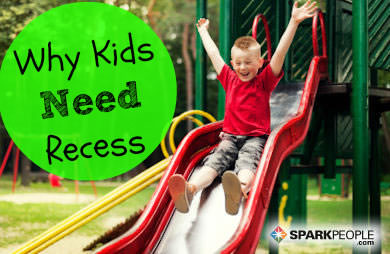
The Benefits of a Positive Recess Environment


Everyday, elementary school children are given the opportunity to take a break from their schoolwork and go outside for recess. There are many benefits of allowing children to take recess breaks during school. From an educational perspective, children are found to be more attentive to academic work following recess and demonstrate improved cognitive performance on school related tasks (Pellegrini & Bohn, 2005). Recess can provide exercise and physical activity for children as a preventative measure for obesity (Barnett, O’Loughlin, Gauvin, Paradis, & Hanley, 2006). The social implications of recess are substantial and have a lasting effect on the developing child. Interacting with peers (rather than adults) at recess is a predictor of positive school achievement (Pellegrini & Smith, 1993), and the opportunities that exist for social interaction assist with developmental tasks—such as improved social skills and cooperative play—and building close relationships with peers (Pellegrini & Bohn). In general, recess behavior is a positive predictor of social cognitive development in children (Pellegrini & Smith). In addition to being proven in studies, teachers and parents often witness these positive outcomes of giving children a recess break during school.
Although recess time provides students with opportunities for positive growth, children don’t always necessarily receive these benefits. For many children, recess is not a time for positive social interaction or physical activity. It is important to keep children active and engaged on the schoolyard at recess and break times. Given the potential recess has for influencing the educational, cognitive, and social development of children, it is important that we take steps toward creating a positive recess environment that supports and encourages children to experience the benefits of recess time. Here are a few ways that peer-led, organized games on the schoolyard can help with this goal:
1.      Provides opportunities for inclusion and social interaction in play
Research on the benefits of peer interaction at recess suggests that peer-led games may be an excellent way of allowing children to engage in positive, meaningful interaction. Social skills and peer relationships often develop within the context of active, social games such as tag, soccer, and jump-rope (Pellegrini & Bohn).
2.      Provides structure in order to decrease opportunities for bullying
The elementary playground/schoolyard was found to be a school location where the highest frequency of bullying takes place (Vaillancourt et al., 2010). Organizing structured activities on the schoolyard may reduce bullying, as children are engaged in goal oriented, cooperative and, often, competitive tasks.

Let’s set our children up to succeed. If we do our part to create a positive recess environment, our children will thrive.

References:
Barnett, T. A., O’Loughlin, J., Gauvin, L., Paradis, G., & Hanley, J. (2006).
Opportunitites for student physical activity in elementary schools: A cross-sectional survey of frequency and correlates. Health Education & Behavior, 33(2), 215-232.
Pellegrini, A. D. & Bohn, C. M. (2005). The role of recess in children’s cognitive
performance and school adjustment. Educational Research, 34, 13-19.
Pellegrini, A. D. & Smith, P. K. (1993). School recess: Implications for education and
development. Review of Educational Research, 63(1), 51-67.
Vaillancourt, T., Brittain, H., Bennett, L., Arnocky, S., Mc.Dougall, P., Hymel, S., …
Cummingham, L. (2010). Places to avoid: Population-based study of school reports of unsafe and high bullying areas at school. Canadian Journal of School Psychology, 25(1), 40-54.

Written by: Shea Wood, Dynamix Montreal office.


Dynamix: Team-building for Kids and Teens, since 2002.
Picture taken from Google Images, source: http://www.sparkpeople.com/blog_photos/main/BigImages/recessG.jpg

Thursday, October 24, 2013

Strong Teams Stick Together: A Lesson in Cooperation

"Cooperation" author Virginia Burden summarized, "is the thorough conviction that nobody can get there unless everybody gets there." At Dynamix, we have multiple activities centered on this principle; games designed to encourage our students to move as one unit and arrive at their goal together. These are my favourite types of games because you can see group-consciousness forming in young minds right before your eyes. A child who loves being the fastest runner in her class, for example, decides to slow down so that her team can move at a more careful pace - an especially important choice as her team is trying to carry a pyramid of cups balanced on a board while only holding its strings! (It is as cool as it sounds - request 'Pyramid Insanity' for your next Dynamix Event!)

However, it took an extraordinary group of eight and nine year olds to show me the essence of Burden's point. We were playing an old Dynamix standby in which each team must travel to different "islands" (hula hoops) as a group using "magic floating" (foam) boards without falling into the "ocean" (floor). Once the whole team has one foot on their island (in the hula hoop), they are allowed to plant their team flag on it and move onto their next one. That's the key - everyone has to be there; they can't leave anyone behind. A little boy, whom I will rename "Arnold," was growing frustrated with this game. Travelling by foam boards requires the kids to squish together, and so allow their personal space to be invaded. Arnold appeared increasingly upset by this arrangement and made the choice to sit out for a few minutes to calm down. When Arnold's team arrived at their first island I asked, as I always do at this point of the game, "Ok, is everyone here? Can I give you your flag?" And, to my delight, many on the team replied, "No!" and pointed to Arnold. They had not forgotten about him; he was part of their team and they could not complete the task without him. Arnold beamed with pride as he rejoined his team to plant their flag.

Anyone who works with kids will agree that their choices are constantly surprising and insightful. That day, Arnold and his team showed me that it is not so much the destination that is important. After all, Arnold's team did make it to their first island without him. Of most significance to them was that they complete the task together. It is often the case in school or at work that one assertive member of a team takes over a project. The task gets done, but the team as a unit is unsuccessful. Cooperation, then, is the thorough conviction that nobody can accomplish their goal unless everybody helps to accomplish it. 

By Shira Lurie, Dynamix lead facilitator, Toronto Office


Dynamix: Team-building for Kids and Teens, since 2002.

Wednesday, October 16, 2013

Making a Difference through Empathy

How do we educate our children about essential character traits that will help guide them to make good choices?  What traits are important to foster in our children?

I was reading through this list of “amazing kids who make a difference” and was thinking to myself, what is at the heart of these children’s kindness and giving spirit? What is a trait shared by these children that contributes to their ability to make a difference in the lives of others?
I realized that it is Empathy.
Empathy is the ability to understand how someone else might feel; to put one’s self in “someone else’s shoes” and consider how another person is affected by their life circumstances and experiences. Empathy is essential. Empathy is at the foundation of qualities like kindness, respect, loyalty, and patience.
Many of the children in this list have seriously considered how someone else is feeling and, in turn, have taken action to improve the lives of others. Empathy can lead to taking initiative to help people; learning to be empathetic changes our behavior towards others. It’s important to teach kids how to be empathetic, but it’s also necessary to help kids realize that, once they understand how someone else might be feeling in a certain situation, they can actually make a difference and change those feelings through their own actions.
Children who have empathy are less likely to bully and more likely to intervene to stop bulling. It’s harder to hurt someone or standby and watch someone be hurt when we are tuning in to how they are feeling and how we would feel in a similar situation. 

It’s important to realize that empathy is a learned trait.
So, how do we teach our children to be empathetic?

1.      Don’t shush, discuss – In moments when children say or do things that could be hurtful to others, discuss the situation rather than simply telling them not to say or do those things. Discussing why their words or actions could be hurtful to others, a child can start to think about how another person might feel and how their actions contribute to those feelings.

2.      Model it  - If the adults in a child’s life model empathy, the child is far more likely to understand and acquire this trait. Talk through it and verbalize what you’re doing as you demonstrate empathy. For example, if you stop to help someone pick up coins that they have dropped while with a child, tell them afterward that you helped because the person may have been embarrassed or upset about dropping the coins, and helping that person to pick them up may have made them feel better.

3.      Praise it - Kids need to see themselves as capable of changing feelings, so when a child does something kind to another person, point it out and praise it! Make sure to be specific and mention the feelings involved. For example, “Annie looked really happy when you shared your toy with her. That was a very nice thing for you to do!”

4.      Ask questions – Asking a child to consider how someone else might be feeling is a good way to encourage empathy. Whether you are reading a story, watching tv, grocery shopping, or going for a walk, don’t be afraid to ask a kid how they think someone else might be feeling in a certain situation. For example, if you see a child being left out of a game, you could ask “how do you think this boy feels to be left out of the game?” or “how do you think it would feel to be left out of the game?”

Discussing situations where children are not being empathetic, praising children when they are, modeling empathy, and asking questions about feelings are all simple ways that we can foster the development of empathy in our children. If we are able to raise kids who have the ability to think about how someone else is feeling and in turn, treat that person with kindness and respect, we will have a whole generation of children who make a difference, in subtle and in big ways!

Written by: Shea Wood.


Dynamix: Team-Building for Kids and Teens, Since 2002.

Picture taken from Google Images: http://www.parenting.com/sites/parenting.com/files/imagecache/gallery_image/_images/201101/psy0211_koy_opener.jpg