Wednesday, March 5, 2014

Effective Communication in Teams: Receiving Messages

In order to work cooperatively and successfully as a team, we must develop the skills to communicate effectively. While my previous article focused on tips for sending messages, this article will describe some helpful tips for receiving messages. Receiving a message skillfully is just as important as sending a message, and the way we listen and respond to a message sent by a team member can have an impact on our relationship. When we listen and respond in ways that are accurate and relevant, we communicate to our teammate that we care about what they have to say and have a desire to understand them. When we fail to listen and respond inappropriately we send the message that we don’t care about what our teammate has to say and are not interested in understanding them. Here are a few tips when receiving messages!

Tip #1: Actually Listen
Often when we are receiving messages from our teammates (either verbal or non-verbal messages, such as gestures and facial expressions), we are preoccupied with our own feelings and ideas, which may prevent us from actually receiving the intended message. When a teammate is sending an intentional message, such as sharing an idea, strategy, or a feeling they are experiencing, try to stay present and actually take in the information so you can respond accordingly.

Tip #2: Try Paraphrasing
It may feel awkward at first, because it doesn’t come naturally, but when someone communicates a message to us, try paraphrasing it back to him/her. Paraphrasing means simply restating the message in our own words. For example, if a teammate says in a group discussion “I feel like no one is listening to me”, you may reflect this back by saying “you feel like you’re not being heard in this conversation”. Paraphrasing can help ensure that you’ve understood the message, while at the same time, making the speaker feel validated and heard in his/her expression of the message.

Tip #3: Check the Meaning
After paraphrasing, or reflecting back the meaning of the message in our own words, it can be very important to check if you got it right. When you paraphrase and then ask your teammate “is that what you mean?” after they have communicated an opinion, idea, or feeling, it provides him/her with the opportunity to agree or clarify the message. Once again, this communicates to the sender of the message that we care about what they are saying and it is important to us that we understand the meaning of their message. This can increase trust in a team and suggests your desire to cooperate. 

In teams, we should constantly be focused on developing strong, meaningful relationships that are not only personally rewarding, but also help to bring us closer to our mutual goals. When we focus on receiving the messages being sent by our teammates, reflecting them back through paraphrasing, and making sure we accurately understand the meaning and intention of the messages, we are communicating to our teammates that we care about them. Therefore communicating does not only help a team achieve mutual understating, but it also helps us to strengthen our relationships.
For more information, see Johnson (2014). Keep an eye out for my follow-up article on tips for overcoming possible obstacles to communication!

Reference
Johnson, D. W. (2014). Reaching out: Interpersonal effectiveness and self-actualization (11th ed.). Upper Saddle River, NJ: Pearson.


Written by Shea Wood, M.A., CCC

Dynamix: Teambuilding for Kids and Teens, since 2002.

Picture taken from Google Images: http://www.rooseveltschoolsb.org/wp-content/uploads/2011/09/Volunteer_Jen_read1.jpg

Wednesday, February 26, 2014

Five Reasons to Send your Kid to Camp!

Although it seems like this winter will never end, summer camp registration is right around the corner. Camp offers unique opportunities for learning and growth that go beyond what is available to kids at school. Whether it is overnight, day, or a specialty camp, here are five reasons you should sign your child up!

1. An ACTIVE Summer
During the school year, kids spend most of their days sitting behind a desk, so it is essential that summer is a time of action! Camp games and activities will get your child moving in an enjoyable and safe environment. The excitement and spirit of camp will also teach your child that an active lifestyle is tons of fun.

2. An OUTDOOR Adventure
Most of camp life takes place outside. Whether it is nature based activities, like hiking and campfires, or sports, like swimming and capture the flag, your child will be immersed in what the great outdoors has to offer. They will benefit from the fresh air and sunshine, while also gaining an appreciation for nature.

3. A LEARNING Opportunity
There are so many opportunities to try new things at camp. One day it may be archery, the next pottery, and the next boondoggle bracelet making! Your child will have a blast learning new skills and trying things they have never done before. Camp also provides the chance for your child to improve at their favourite sports and activities, like dance or basketball.

4. A CONFIDENCE Booster
Part of learning new things is having new successes. As your child racks up achievements throughout the summer, they will increase their self-esteem and sense of accomplishment. In addition, the independence that camp offers will further develop their confidence and self-sufficiency. They will go back to school in September knowing they can learn new skills, improve through practice, and rely on themselves – a teacher’s dream!

5. A SOCIAL Environment
Camp is a great place for kids to meet new people and form friendships. By placing them outside their familiar environment, camp enables kids to develop their social skills among all different types of people. They will also get the chance to look up to their counselors, enthusiastic young adults who can relate to them and be positive role models.

Written by: Shira Lurie, Dynamix Toronto lead facilitator

Dynamix: Team-building for Kids and Teens, since 2002.


Monday, February 24, 2014

Do It Yourself Teambuilding - Double Trouble!


Activity Name: Double Trouble

Materials: Foam dodge balls, Pinnies (optional)

Setup: Have everyone stand in a big circle.

Goal: First team to pass the ball around the circle to each of their teammates back to the first person.

How to play:Make a big circle with everyone. Make two teams in the circle. (Every other person in the circle is one team) pass a ball to the first person in each team. On Go, one team passes the ball to the next player on their team one way and the other team passes the ball the other way. Take a step back after each round.

The rules:
-Cannot block the other team’s ball
-Must pass the ball to each person in the team
-Cannot switch directions

Discussions:
-What was your strategy?
-Talk about you can’t always win and how to deal with it.
-Talk about frustration and how to deal with it
-Why was it important to follow the rules?
-Did you want to intercept the other team’s ball? Why?

Wednesday, February 19, 2014

Effective Communication in Teams: Sending Messages

Our daily lives are filled with one communication experience after the next. Communication between ourselves and those around us is constantly occurring as we exchange messages to achieve an understanding of other people’s thoughts and experiences. Effective communication is essential when working in teams, and developing the skills required to achieve mutual understanding within a team through communication takes practice. The word “team” is being used to describe any grouping of individuals—including a committee, class, sports team, family, or work colleagues—as communication is imperative despite the type of team being discussed. If we need to work collaboratively with others, we need effective communication.
In this article, I will offer some tips for sending messages effectively.

Tip #1: Take Ownership!
It is important to take responsibility for your opinions, ideas, and feelings when expressing them to others. To do this, make personal statements such as “I think…”, “I feel…”, “It seems to me…”. When you own your messages, it suggests that you are honest and open with your teammates, and there has been a level of trust established in the group that allows you to comfortably reveal your thoughts and feelings.

Something to watch out for: How often do you use sentences such as “We think that…”, “Everyone knows…”, “Most of the team feels…”? Take note of this! When we speak for other people, it might feel safer than taking ownership for our thoughts and feelings, but it may lead to confusion, misunderstanding, or inappropriate representation of someone else’s opinion.

Tip #2: Describe, Don’t Evaluate!
When giving feedback on someone else’s behavior, it is important to simply describe what you see without making a judgment about it. When we evaluate another’s behavior, it can create defensiveness and establish barriers to effective communication. It is helpful to use descriptive statements, which describe specifically what you have observed without making assumptions about what that behaviour means about the other person’s attitude, personality, or motives. For example, it can be more beneficial to tell a teammate “you seem to be walking very slowly, what’s going on?” rather than saying “you don’t care about finishing this challenge quickly”. We don’t have all of the information. Maybe the person is sick, upset, offended, tired, or hurt (among other possible reasons for this behavior), so simply giving descriptive feedback can begin a dialogue to establish a deeper understanding of you and your teammates’ experiences.

Something to watch out for: How often do you include judgment or an assumption when giving feedback rather than just describing what you see? Take note of this and see if you can alter your communication when giving feedback!

Tip #3: Take the Other’s Perspective
The same message can mean two different things to two different people. In order to send a message effectively, you need to consider the perspective of the receiver. Perspectives are complicated and complex; they are formed through our values, beliefs, and experiences. We can never be certain or complete in our understanding of another person’s perspective, but if we try to put ourselves in someone else’s shoes, we can create and send messages that are more likely to be received the way we intended. For example, if a teammate has absolutely no experience with soccer, and we consider this before sending our message, we may choose to say “try kicking the ball in the net” rather than “try to score a goal”, because the player may not know what it means to “score a goal”. Through perspective-taking, we can alter our communication so it can be more appropriate for the receiver and therefore more clearly understood.

Something to watch out for: How often do you phrase communication based on your own knowledge and experience without considering the perspective of the person your communicating with?

For more information, see Johnson (2014). Keep an eye out for my follow-up articles on tips for receiving messages effectively and overcoming possible obstacles to communication!

Reference
Johnson, D. W. (2014). Reaching out: Interpersonal effectiveness and self-actualization (11th ed.). Upper Saddle River, NJ: Pearson.


Written by Shea Wood, M.A., CCC

Dynamix: Team-building for Kids and Teens, since 2002.

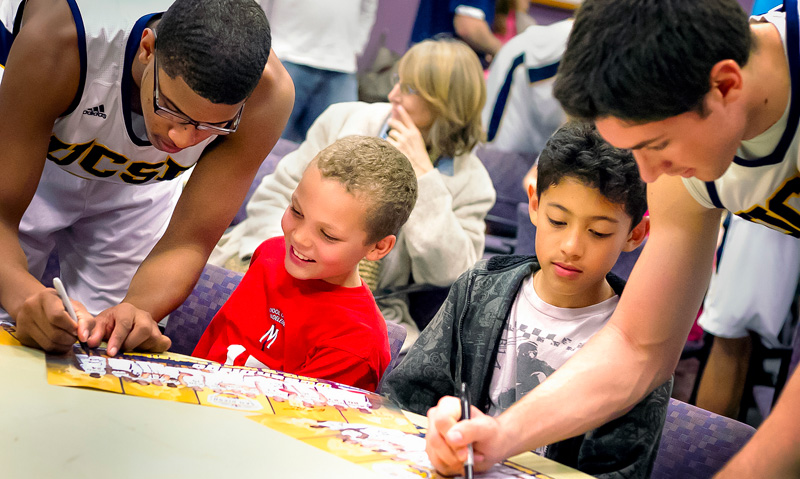
Picture taken from Google Images: http://ucsdnews.ucsd.edu/news_uploads/130321athletics1.jpg

Wednesday, January 15, 2014

Do it yourself teambuilding: Lily Pads


Activity Name: Lily Pads

Materials: Hula Hoops (1 per person)

Setup: Start by scattering 1 hula hoop per person around your entire playing area.  A 25’ by 25’ room is great, but this game can be played in different sized spaces.

Goal: To get everyone safely on a Lily Pad (in a hula hoop), even as Lily Pads disappear!

How to play:
Call out different ways for the group to move about the open space (e.g. walking, skipping, marching, running, chicken dance, etc.).  When you call “Jump on a Lily Pad!” everyone must run to a hula hoop and jump into it.  More than one player can share a hoop. After each round, you can take one (or several) hula hoop away.  As you eliminate more hoops it will require your group to cooperate by sharing hoops and including others.

Discussion:
- Did the activity get easier or harder as Lily Pads were removed?
- What did you do to overcome that challenge?
- What does it mean to include someone? How was that important in this activity?
- Where else could we try to do a better job of including others?

Learning to Lead: Practicing Leadership Through Gameplay

We often think of leaders as naturally assertive and charismatic people. We envision Presidents, Generals, and CEOs as born leaders, destined to be in charge. By cultivating the myth that leaders are born, not made, our kids develop a narrow impression of who can be a leader in their own world. Perhaps it is the person who speaks the loudest or the one with a Captain’s “C” on their jersey. Children who fall outside of these categories become hesitant to take on leadership roles and so do not develop their leadership skills, reconfirming their belief that they are not fit to lead.

We must teach our kids that leadership is not an inherited ability, but rather a skill that takes practice to master. At Dynamix, we believe that learning and fun should go hand in hand. So, here are three simple games that each offer a different leadership learning opportunity for your group:

1. Call and Follow - Rotate Responsibilities
GOAL: To have multiple children practice leadership through communication. 
SET-UP: Blindfold all but one player. Have the blindfolded children form a train with their hands on each other's shoulders. Have the non-blindfolded player, the "Caller," stand on a chair.
GAME: The Caller guides the blindfolded train around the room using only their voice. To increase the challenge, scatter obstacles, like pylons, around the room for the group to avoid. 
LEADERSHIP LEARNING OPPORTUNITY: Have children take turns being the Caller. This will give multiple children the chance to practice their communication skills and feel in charge of the group. It will also allow everyone else to practice following different people's directions. 

2. Blind Crossing - Creative Twists
GOAL: To give less assertive children the chance to lead.
SET-UP: Scatter a few hula-hoops around the room. Have the whole group hold onto one long rope.
GAME: The entire group must cross from one end of the room to the other by only stepping inside the hula-hoops and never letting go of the rope. 
LEADERSHIP LEARNING OPPORTUNITY: Add a twist by blindfolding a few of the more assertive group members. For an extra challenge, you can also tell the blindfolded people they are not allowed to talk. By limiting the influence of the group's natural leaders, other children will have the opportunity to step up and fill the leadership void. In addition, it will give your traditional leaders the chance to practice listening to others. 

3. Find the Leader - Leadership by Example
GOAL: To demonstrate the power of leading by example. 
SET-UP: Have the group sit in a circle. Pick one child to be the “Detective” and have them wait outside of the room. Pick one person in the circle to be the “Leader.”
GAME: The group must watch the leader and copy whatever action they are doing at the time. The Leader must switch the action frequently. The detective must reenter the room and try to guess which person is the leader by watching the group. 
LEADERSHIP LEARNING OPPORTUNITY: After the game, discuss what it means to lead by example – through our actions, not our words. Have the group think about the power of our actions and how positive and negative choices may influence other people. 


Written by: Shira Lurie, Dynamix Toronto lead facilitator


Dynamix: Team-building for Kids and Teens, since 2002.

Wednesday, January 8, 2014

Building Relationships in Teams: Self-Disclosure and Trust


When people work in teams, they build relationships. Strong relationships allow for more productive and meaningful teamwork and collaboration. This cycle highlights the importance of relationships in teamwork. Relationships develop through working in teams and relationships enable individuals to work together in meaningful ways.
Given the importance of building strong relationships, it is essential to consider what skills and behaviors lead to the creation of a strong and fulfilling relationships. By assisting children in developing these skills and behaviors, you are giving them tools to build a successful future that inevitably will require—and be enriched by—creating relationships and working with others. 
Self-Disclosure
Self-disclosure is an act of revealing your thoughts and perspective about a present situation, or other relevant and meaningful information, to another person. Sharing personal thoughts is crucial when building relationships in teams. Self-disclosure allows team members to get to know one another better, identify common goals and overlapping values and, once common goals have been identified, allows you to work together toward accomplishing these goals. Just as strong relationships and teams are built through appropriate self-disclosure, the lack of self-disclosure between team members can result in the deterioration of relationships and influence the strength of a team. If an individual keeps quiet about his/her needs, desires and goals, other team members are likely to do the same; people in relationships tend to match the amount of disclosure coming from others. A breakdown in communication can lead to a team where members are not working together or recognizing and valuing one another’s needs and desires.
Trust
It is well known that trust is the foundation for building and maintaining meaningful, productive relationships. This is certainly true of building relationships within a team, and when trust is established, team members are far more likely to take risks, communicate important information, and share personal thoughts and feelings through self-disclosure. Similar to the concept of self-disclosure, levels of trust are matched in relationships, and if one individual takes a risk and trusts others in the group, other team members are more likely to do the same. Feeling as though someone else trusts you makes it easier for you to trust that person in return. Johnson (2014) offers helpful hints about trust, and there are four that I believe are extremely helpful to remember when developing relationships within teams:
1.      Trust is hard to build and easy to destroy: building a high level of trust within relationships can take a long time, and one act of disloyalty can eliminate trust in a relationship.
2.      The key to building and maintaining trust is being trustworthy: as Johnson (2014) says, “when you want to increase trust, increase your trustworthiness” (p. 99).
3.      Trust needs to be appropriate: always trusting and never trusting is inappropriate. Evaluate the situation and trust yourself in knowing when it is important to extend trust to others.
4.      Cooperation increases trust; competition decreases trust: generally, trust develops between individuals who are working with one another rather than against one another.

Self-disclosure and trust are necessary in building relationships in many different contexts, including sports teams, the work environment, friend groups, and families. If adults can model these skills and behaviors, not only will the adults have more fulfilling and meaningful relationships, they will begin to teach their children how to build fulfilling and meaningful relationships in all areas of life.

Reference
Johnson, D. W. (2014). Reaching out: Interpersonal effectiveness and self-actualization (11th ed.). Upper Saddle River, NJ: Pearson.

Picture taken from Google Images: http://georgeclerie.files.wordpress.com/2012/08/kids-on-dock2.jpg

Written by Shea Wood.


Dynamix: Team-building for Kids and Teens, since 2002.